Life with PDA
Helpful approaches
https://www.pdasociety.org.uk/life-with-pda-menu/family-life-intro/helpful-approaches-children/
Understanding behaviours
Anxiety
- undeerstand and accept that a child’s behaviours are underpinned by anxiety and a need for control
- anxiety can be expressed by avoidance, anger, cruing, laughing, not talking, fidgeting, obsessing, skin picking, running off, masking, throwing, etc
- the 5 point scale / anxiety curve models
Adjust your mindset
- look beyond surface behaviours
- re-balance your relationship
- try not to take things personally and model desired behaviours
- focus on the long term objective: building a child’s ability to cope
- be flexible in finding an approach that works
Optimise the environment
Typically developing child: put in place firm boundaries, use rewards, consequences and praise. PDA child: develop an approach based on negotiation, collaboration and flexibility.
- balance tolerance and demands
- appreciate that a child’s tolerance for demands varies
- try to control the making of demands and build in downtime for anxiety to reduce and the child’s tolerance to recover
- agree non-negotiable boundaries
- sharing clear reasons for boundaries, and agreeing them as a family, can help children to adhere to them
- allow plenty of time
- remember time is a demand
- so plan ahead and allow plenty of time
- have an exit strategy
- important to know how to extract yourself from a challenging situation
- eg, you might agree a quiet zone where a child can retreat to or provide reassurance that if something can’t be done today it can be tried again tomorrow
Reducing the perception of demands
Declarative langugage handbook
Typically, this means reframing demands to make them seem less “demandy”. A mixture of approaches usually works best: Phraseology and tone
- use declarative language (statements, comments or observations)
- “You need a coat on outside” rather than “Put your coat on”
- “The clothes are on the bed, I’m happy to help” and then walk away, rather than “You need to get dressed now”
- place the drink near child and say “Here’s a drink”
- rephrasing to talk about an object rather than a person
- starting rather than ending requests with the word ‘please’
- indirect phrases that include an element of choice
- “I wonder whether…”
- “Let’s see if…”
- “Maybe we could…”
- “An idea could be…”
- avoid trigger words
- “no”, “don’t”, “can’t”
- instead: “It’s not possible right now” and explain while offering an alternative
- “I’m afraid it’s not possible to go to the park right now because there’s a storm, but we can try this afternoon when the forecast is better and in the meantime would you like to bake a cake or watch a film?”
indirect communication
- physical prompts
- eg tap shoes, point to the coat
- visual prompts
- eg pictures or checklists - choice can be offered by letting child choose the order of tasks
- telling someone else to do something in child’s hearing
- eg “I wonder if we could get the toys put away”
- leaving books or leaflets around for child to pick up out of natural curiosity
- communicating via role play
- eg “I wonder if the teddy bear would like to go to bed now”
- depersonalising
- invoke a higher authority (“we can’t eat inside because the rules say so”)
- distract / gamify
- “let’s list the top 10 dinosaurs” whilst getting into the bath.
- use humour
- ask for help
- ie say you don’t know or can’t remember as an indirect demand “I can’t remember where the coat hangs up”
- offer choices and accept a compromise
- eg “would you like a bath at 6 or 7?” and accept 6.30
- stock a fridge shelf with healthy snacks and let child choose
- model demands/behaviours yourself without putting any pressure or expectation on child
- “I’m feeling really stressed right now so I’m going to lie down in a quiet room and listen to some whale songs to help me to calm down.”
Be cautious with rewards/praise/sanctions
Rewards
Rewards create an additional demand - if the thing isn’t achieved, the reward isn’t either, magnifying the problem. They also don’t address the underlying difficulty / lack of skills which are preventing achievement.
What can work:
- surprise rewards (as there has been no expectation)
- immediate rewards (as the child can see the link between the behaviour and the reward)
- tangible rewards (objects related to child’s special interest, rather than stickers)
Praise
Praise can be a demand to repeat or improve on previous performance, and encouragement is a demand as it increase expectation.
What can help:
- Praise results rather than person (e.g. “what a wonderfully tidy room” rather than “well done for tidying your room”)
- praise child to a third party within child’s hearing (comment to partner “child did so well walking to the shop”)
- offer exit strategies when encouraging (“It would be great for you to go to the cinema with your friends, but don’t worry if it feels too much once you’re there, you can call me and I’ll come and pick you up”)
Sanctions or consequences:
- feel unfair when the child feels they can’t do something
- can appear arbitrary when not directly linked to the behaviour (eg where’s the link between using iPad and being mean to sibling?)
What can help:
- natural consequences (eg can’t watch ipad if it gets broken during a meltdown)
- discussing ways to avoid difficult situations from arising in future when everyone has calmed down
Supporting sensory needs
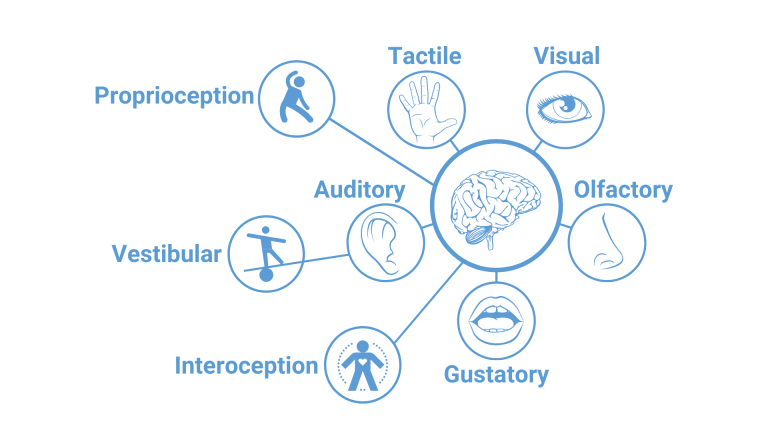
- PDA children may be hyper-sensitive (seek to avoid the sense), hypo-sensitive (seek more of the senses), or both.
- It is possible to be hyper- and hyop-sensitive to the same sense
- eg enjoying your own voice or music choice, but not liking someone else’s
- Sensory needs can change over time, and depending on other factors (eg tiredness, hunger, anxiety)
Sensory vs behaviour
- Sensory needs can be mistaken for behaviour
| Sensory | Behaviour |
|---|---|
| has a meltdown every night during the gettingready-for-bed routine | is more compliant with toothbrushing for dad than for mum |
| would go all day without liquids if we didn't let her drink from her bottle | refuses to try new foods but she eats several snacks every day |
| cannot self-soothe | escalates if we ignore the tantrum |
| bites her wrist when she is frustrated | bites her brother when he takes her toy |
| meltdowns are predictable | meltdowns happen in a variety of situations and settings |
| consistently does better at ____ " (home, school, grandma's house) | struggles in every setting if she doesn't get her way |
| doesn't seem to be aware that he has a wet nappy | asks for a nappy change soon after peeing or pooping |
| struggles with changes in routine | struggles with following directions |
| acts out during transitions | acts out when mum is taking care of his baby sister |
| Table from Sensational Brain | |
What can help:
- chewy toys for oral sensory input
- headphones for children who become overstimulated by noise and crowds
- fidget toys for tactile input
- opportunity for movement and exercise
- scented objects for children who are distressed by unfamiliar smells
- Seamless socks, wide fitting shoes and cutting labels out of clothes for those who are hyper sensitive to touch
Resources
- Making Sense of Behaviour booklet
- Sensory Processing Disorder Checklist
- Resources and ideas from Sensational Brain
Supporting social communication and interaction
Communication
- allow processing time
- eg count to 5 to give a child time to process and thing about a response
- chunk questions
- eg “what did you do at school today?” is a big question, “what did you do at break time?” is a smaller question
- allow time for a child to answer before asking a follow-up
- be clear and precise whilst being indirect
- ““I wonder if you could help me. I need four blue cups, from that cupboard, to be put on the table in the kitchen”.
Social interaction
- role play can help a child understand other people’s perspectives
- TV/books/gaming can enable indirect development of social skills
- link activities to special interests (eg child could be teacher for a game)
Supporting emotional well-being
- focus on positive qualities
- remind child they are valued for tho whty are and that they are loved
- support and indulge them with the things that they’re interested in rather than trying to impose on them what you feel they should be doing
- speak about them in positive terms to other people e.g. “Millie has an amazing imagination, she always thinks of really good games to play” or “Luke really makes me laugh, he’s such good fun to be with.”