What is PDA?
What are demands?
- Direct requests or questions
- eg ‘put on shows’, ‘sit and wait’, ‘would you like a drink?’
- indirect demands
- eg praise (leads to anxiety over future performance rather than positive reinforcement), uncertainty (need to know and feel in control of what’s going on)
- demands within demands i e, smaller implied demands within demands (eg going to theatre implies be quiet and stay seated)
- plans
- advance planning can lead to anxiety as time for the plan nears
- intolerance of uncertainty can make spur of the moment decisions sources of anxiety
- ‘I should” demands
- eg getting u, washing, dressing, eating, sleeping etc
- Things we want to do!
- eg hobbies, seeing friends,
What is demand avoidance?
- not being able to do certain things at certain times, for yourself or others, and things we do in order to avoid demands
- pathological refers to it being all-encompassing
- avoding demands because they are demands, sometimes the expectation leads to a feeling of lack of control, which increases anxiety and panic
- can be irrational, eg a dramatic reaction to a tiny request, or feeling hungry stopping someone being able to eat
- avoidance can vary
Avoidance approaches
- distraction (changing the subject or engaging in interesting conversation)
- procrastinating
- excusing yourself (giving explanations as to why you can’t comply)
- incapacitating yourself (saying ‘my legs don’t work’)
- withdrawing into role play or fantasy
- reducing meaningful conversation.
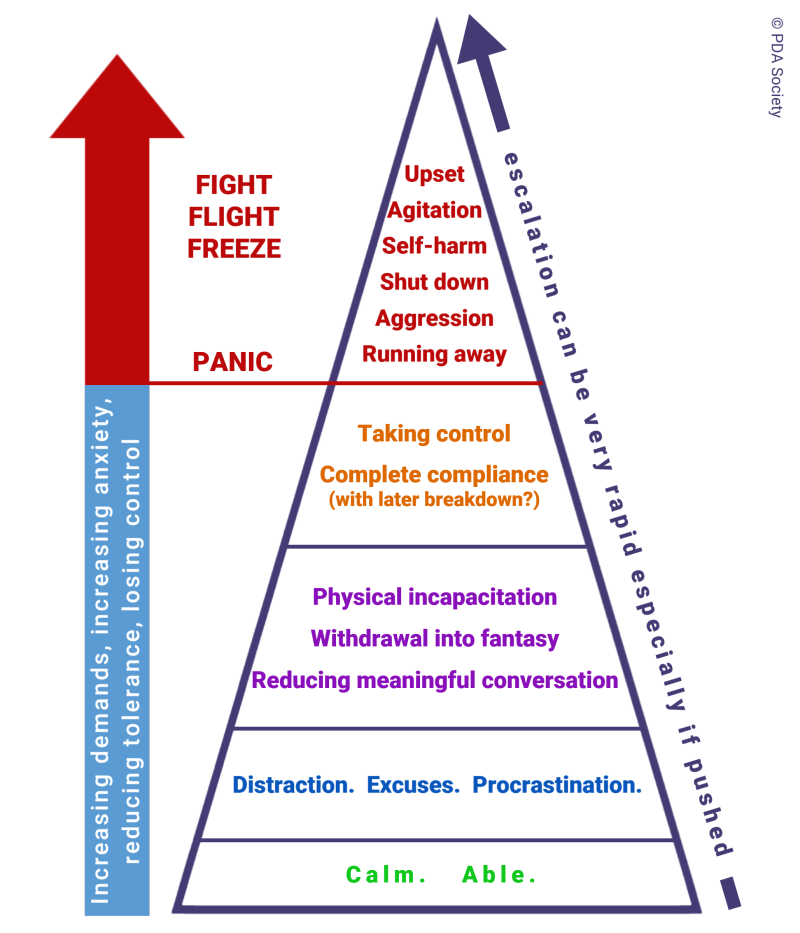
If these approaches don’t work or aren’t noticed by others, escalation to panic can be rapid as a lack of choices / options to retain control is felt. Meltdowns in PDA are best understood as being like panic attacks.
Identyifying PDA
- often missed, misunderstood, or misdiagnosed
- eg as Oppositional Defiant Disorder (ODD), Conduct Disorder (CD),Reactive Attachment Disorder (RAD), Personality Disorders or Developmental Trauma
Helpful approaches
Conventional approaches are often ineffective and even counter-productive
- conventional examples: firm boundaries, the use of rewards, consequences and praise
- typical approaches recommended for autism: routine, structure and predictability
Better for PDA:
- low arousal approaches, which keep anxiety to a minimum and provide a sense of control
- aim to establish a partnership based on trust, flexibility,, careful use of language and balancing of demands
How to help
- recognise what demands are, how they are avoided, and be aware of triggers
- accept the demand avoidance and work to avoid triggers
- work to reduce demands, and have demand-free time
- person-centred counselling, mindfulness or meditation
Books: https://www.pdasociety.org.uk/resources/resource-category/books/ can you see me https://www.amazon.co.uk/Can-You-See-Libby-Scott/dp/1407195670 PDA by PDAers https://www.amazon.co.uk/PDA-PDAers-Anxiety-Avoidance-Meltdowns/dp/1785925369/ref=asc_df_1785925369/
Understanding PDA: For Kids & Grown Ups https://www.amazon.co.uk/Understanding-PDA-Kids-Grown-Ups/dp/B0C87DFHQ1
For kids The panda on PDA https://www.amazon.co.uk/Panda-PDA-Childrens-Introduction-Pathological/dp/1839970065/ The PDA-Saurus https://www.amazon.co.uk/PDA-Saurus-Sophie-Cook/dp/1399957023